
Choosing the right engineering plastic and selecting the ideal polymer for industrial components can be challenging. While PA6 (Nylon 6), PA6+MoS2 (Nylon + Molybdenum Disulfide), and POM-C (Acetal Copolymer) look similar, they behave differently under load, moisture, and friction.
This article breaks down their technical mechanics, strengths, and ideal use cases to help you make the right engineering choice.
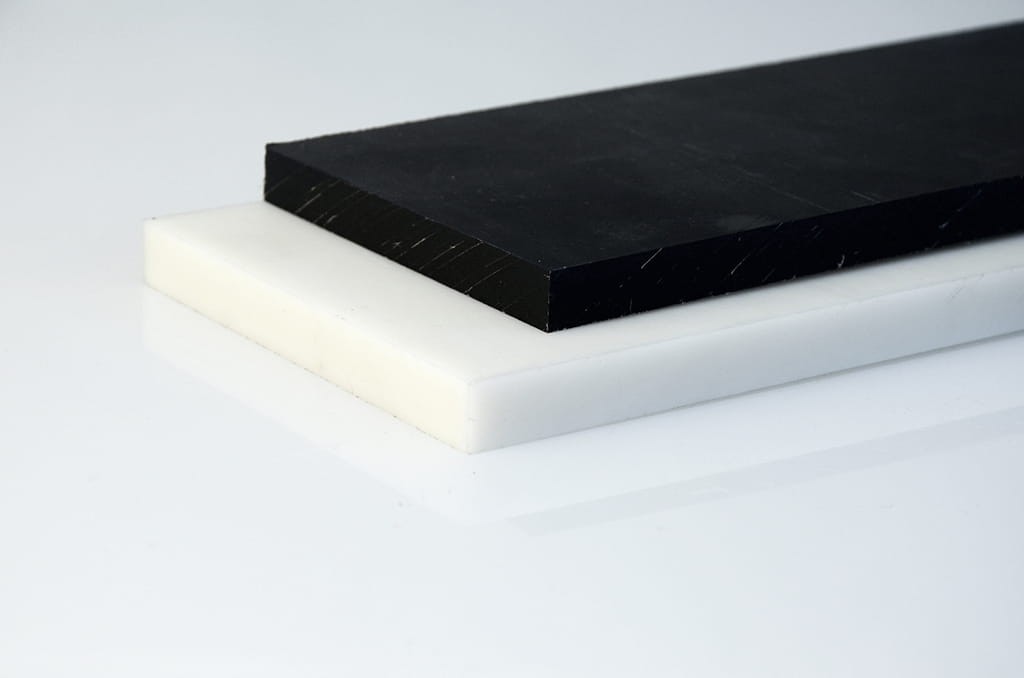
What does each technical plastic provide?
- Choose PA6 (Standard polyamide) if you need maximum impact toughness, shock absorption, and resistance to heavy vibrations, and your parts operate in a stable, dry environment.
- Choose PA6+MoS2 (Polyamide filled with molybdenum disulfide) if you need the toughness of PA but your part will undergo continuous sliding, rotating, or heavy friction without external lubrication.
- Choose POM-C (Polyacetal) if you need high dimensional precision, stiff parts that do not flex under load, and zero swelling or structural changes when exposed to water or humidity.
In-Depth Technical Breakdown
PA6 (Polyamide 6 / Nylon 6)
A Tough Shock-Absorber
PA6 is a highly durable, versatile engineering plastic. At a molecular level, it contains strong intermolecular hydrogen bonds, giving it incredible resistance to impacts and sudden fractures.
- The Catch: Nylon is highly hygroscopic (it acts like a hard sponge, absorbing around 2.5-4% water from ambient humidity). As it absorbs water, its physical properties change drastically: it swells in size, loses up to 50% of its tensile stiffness, but doubles its impact resistance.
- Best For: Heavy-duty structural parts, impact plates, and machine frames where toughness is valued over tight tolerances.
PA6+MoS2 (PA6 / Nylon 6 + Molybdenum Disulfide)
Perfect for self-lubricating applications
This material takes standard PA6 and infuses it with microscopic particles of molybdenum disulfide MoS₂. This mineral additive acts as an internal solid lubricant and modifies the plastic’s crystalline structure, making it harder and slicker than pure nylon.
- How it Works: During sliding contact, the MoS₂ flakes shear easily at the surface, creating a smooth film that prevents direct polymer-to-metal friction. This prevents the plastic from overheating or transferring residue onto metal shafts. It still absorbs water like standard PA6, but it handles dry-sliding wear significantly better.
- Best For: Unlubricated bearings, high-stress gears, sheaves, pulleys, and fast-moving wear strips.
POM-C (Polyoxymethylene Copolymer / Acetal)
Suitable for precision use
POM-C is a highly crystalline plastic defined by alternating carbon-oxygen bonds. Because its molecular structure lacks highly polar groups, it completely ignores water.
- How it works: POM-C absorbs virtually no moisture (<0.25%). A part machined out of POM-C today will remain the exact same size and stiffness years from now, whether operating in a desert or completely submerged in water. It is naturally rigid, resists flexing under long-term loads, and features an exceptionally low coefficient of friction with zero “stick-slip”.
- Best For: Precision gears, medical devices, automotive clips, and any component requiring tight machining tolerances (0.02\mm) in humid environments.
Engineering Property Comparison
| Engineering Property | PA6 (Nylon 6) | PA6 + MoS2 | POM-C (Acetal Copolymer) |
| Tensile Strength | High (~80 MPa dry) | Very High (~85 MPa dry) | Moderate-High (70 MPa) |
| Impact & Shock Resistance | Excellent (Resists shattering) | Great (Slightly stiffer than PA6) | Great (More brittle than PA6) |
| Moisture Absorption | Very High (~3% at saturation) | Very High (~2.8% at saturation) | Extremely Low (<0.25% saturation) |
| Coefficient of Friction | Moderate (0.35 – 0.42) | Low (0.25 – 0.30) | Very Low (0.20 – 0.25) |
| Dimensional Stability | Fair (Swells/shrinks with humidity) | Good | Excellent (Maintains exact shapes) |
| Max Continuous Temp | Up to \(100oC) | Up to \(105oC) | Up to \(100oC) (Better in hot water) |
Environmental and Chemical Differences
- Water and Steam: Avoid PA6 variants if the part is submerged or must hold tight dimensions in high humidity. POM-C handles moisture perfectly, though standard acetal can struggle with continuous steam sterilization (where specialized grades are preferred).
- Chemical Resistances: Nylons (PA6 and PA6+MoS2) have superior resistance to oils, grease, fuels, and strong alkaline solutions, but are destroyed by mineral acids. POM-C handles solvents and weak acids well but will crack and degrade when exposed to strong acids or chlorinated water.
Contact us
Contact us for a professional and fast consultation on choosing the right engineering plastic for your specific application.